

AVS Extrem

The German Federal Criminal Police Office (BKA) declares in 2006 a 50-percent increase of the thefts of construction sites. The financial loss for landlords and other owners of construction site equipment was estimated with approximately 90 million Euro. Therefore a flexible, spontaneously installable, economical and interface-open monitoring network is necessary. In this project the Freie Universität of Berlin investigates the possibility to establish distributed event detection in wireless sensor networks by deploying a fence monitoring system as an example.
With the help of a distributed and embedded system, events are to be recognized and evaluated. The challenges of the system are: the wireless communication between the sensor nodes, the event recognition in the sensors data and the design of distributed algorithms for adjustment of the detected pattern. The wireless sensor network (WSN) of AVS-Extrem is a self-configuring and self-healing. It is able to supervise the valuable goods existing on construction sites and to differentiate events from each other.
| AVS-Extrem "Autonome Vernetzte Sensorsysteme (mst-AVS)" Vernetzte Sensorsysteme zur Lokalisierung und Überwachung unter Extrembedingungen |
|
Partners
- AVC Systemhaus
- EZENT GmbH
- Freie Universität Berlin
- Nanotron Technologies GmbH
- Rhenus Port Logistics AG
Download Flyer <-
Ziel ist die Erkennung und ortsabhängige Bewertung von Ereignissen mit Hilfe eines verteilten und eingebetteten Systems. Neben der Problematik der drahtlosen Kommunikation zwischen den Sensorknoten stellt die Erkennung von Muster in den Sensordaten, die Entwicklung von dezentralen Algorithmen zum Abgleich der erkannten Muster sowie die Einschränkung bei der Hardware wie begrenzte Rechenleistung, beschränkte Energie Versorgung, Speicherplatz und Prozessorleistung eine große Herausforderung dar.
Zusätzlich zur Ereigniserkennung ist das System mit einem kabellosen Ortungssystem ausgestattet, was die 2D-Lokalisierung eines Sensorknotens ermöglicht. Die Kombination von kabelloser Ereigniserkennung und Ortung ist für den realistischen Anwendungsfall der Überwachung sicherheitsrelevanter Areale sehr interessant.
Im Verbundprojekt „AVS-Extrem“ wird konkret ein selbstkonfigurierendes und selbstheilendes Netzwerk entwickelt, welches in der Lage ist, die auf Baustellen vorhandenen wertvollen Güter mit Hilfe sich autonom vernetzender Sensorsysteme zu überwachen und dabei die Ereignisse bezüglich ihrer Alarmierungsrelevanz eigenständig voneinander zu unterscheiden.
Die dafür nötige Erfahrung als auch Technologie bringen die unten genannten Projektpartner in das Verbundprojekt „AVS-Extrem“ ein.
Das System ist somit
-
einmalig bezüglich der Verknüpfung von Abstandsmessungen von Knoten in einem Netzwerk und der Ereignisdifferenzierung der zu überwachenden Objekte,
-
effizient in der Energienutzung und damit langfristig einsetzbar,
-
variable im Einsatz, kann also für viele Anwendungsbereiche eingesetzt werden, etwa auch in Logistikzentren, Lagerhallen und bei Großveranstaltungen,
-
selbstorganisierend benötigt damit nur wenig Zeit und Aufwand bis zum produktiven Einsatz („plug and produce“).
Die Freie Universität Berlin untersucht und in diesem Projekt die Einsetzbarkeit verteilter Ereigniserkennung in drahtlosen Sensornetzen am Beispiel der Bauzaunüberwachung.
AVS-Extrem: A Use Case for Wireless Sensor Networks
The AVS-Extrem project is a use case for Wireless Sensor Networks (WSNs) focused on collaborative, in-network data processing. The goal is to develop a distributed event detection algorithm that can reliably report security relevant incidents (e.g. a person climbing over a fence) to a base station. The vision is that through cooperation of many sensor nodes the accuracy of event detection can be greatly improved, while at the same time saving energy by reducing multi-hop communication with the base station.
Layered Event Detection Architecture
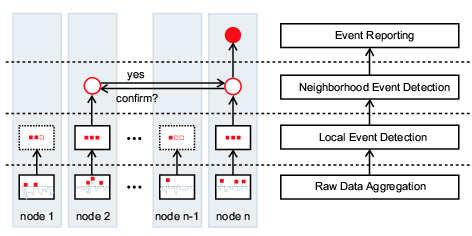
We have taken a layered approach to tackle the problem of in-network event detection, thereby isolating the subproblems of per-node event detection and coordination between neighboring nodes. A diagram of our architecture is shown below.
The different layers of our architecture implement a distributed, multi-step event detection algorithm. In the lowest layer, raw sensor readings are isolated from background noise and aggregated into a set of characteristic properties. The next layer checks whether known patterns appear in these aggregated values and identifies them as event candidates. In the next layer, the sensor nodes collaboratively decide whether a noteworthy event has in fact occurred within an n-hop neighborhood by exchanging information about recently observed event candidates. Finally, the uppermost layer reports confirmed events to the base station of the deployment.
Deployment Videos
In September 2006, we evaluated our event detection algorithm with a small deployment of sensor nodes attached to a construction fence in the patio of our institute. The video below illustrates the types of events we considered in our experiments.
In October 2008, we once again evaluated our reworked event detection architecture on the example of a wireless alarm system. 100 sensor nodes equipped with accelerometers were attached to the fence surrounding a real-world construction site. The task of the WSN was to detect security relevant incidents by recognizing four previously trained patterns in the lateral oscillation of the fence elements. As above, this video illustrates the types of events we considered in our experiment.
In August 2011, we integrated our distributed event detection in a wireless motion-based training device. We showed by the example of Martial Art Stick Fighting that the event detection is able to support people during performing movements. This system may also be useful in rehabilitation scenarios or other wireless body area networks (WBAN). The video illustrates the functionality of the device by performing six simple stick fight techniques.
Relevant Publications
- Freie Universität Berlin AVS-Extrem - Vernetzte Sensorsysteme zur Lokalisierung und Überwachung unter Extrembedingungen. Presentation of the distributed event detection system and its results at the BMBF status meeting in February 2012
- Norman Dziengel, Marco Ziegert, Stephan Adler, Zakaria Kasmi, Stefan Pfeiffer and Jochen Schiller. Energy-Aware Distributed Fence Surveillance for Wireless Sensor Networks. In Proceedings of the 7th IEEE International Conference on Intelligent Sensors, Sensor Networks and Information Processing (ISSNIP '11)
- Norman Dziengel, Nicolai Schmittberger, Jochen Schiller, Mesut Günes and Jochen Schiller. Secure Communications for Event-Driven Wireless Sensor Networks. In Proceedings of the 3rd International Symposium on Sensor Networks and Applications (SNA '11)
- Norman Dziengel, Marco Ziegert, Stephan Adler, Zakaria Kasmi und Jochen Schiller. Herausforderungen der verteilten Ereigniserkennung in drahtlosen Sensornetzen. In: Mikrosystemtechnik Kongress 2011, Darmstadt, Germany (MST 2011)
- Heiko Will, Stefan Pfeiffer, Stephan Adler, Thomas Hillebrandt and Jochen Schiller. Distance Measurement in Wireless Sensor Networks with Low Cost Components. In: 2nd International Conference on Indoor Positioning and Indoor Navigation (IPIN 2011)
- Norman Dziengel, Marco Ziegert, Martin Seiffert, Georg Wittenburg, and Jochen Schiller. Integration of Distributed Event Detection in Wireless Motion-Based Training Devices. In Proceedings of the 1st IEEE International Conference on Consumer Electronics (ICCE '11), Berlin, September 2011.
- Jochen Schiller, Talk: Der nächste Schritt - Funksensornetze im praktischen Einsatz RFID für mobile und webbasierte Anwendungen – Trends und Branchenlösungen September 2011
- Georg Wittenburg, Norman Dziengel, and Christian Wartenburger. Verfahren und Sensornetz zur Merkmalsauswahl für eine Ereigniserkennung. German patent DE 10 2009 006 560 B4 (WO 2010/086325 A1) June 2011. (DPMA)
- Norman Dziengel, Nicolai Schmittberger, Marco Ziegert, Stephan Adler, Zakaria Kasmi, Stefan Pfeiffer, Martin Seiffert und Jochen Schiller Geländesicherung AVS-Extrem - Autonome Vernetzte Sensorsysteme in extremen Umgebungen. Forschungsforum Öffentliche Sicherheit Workshop, Kriminalität - alte und neue Herausforderungen für die Sicherheit, Poster, Berlin, March 2011.
- Nicolai Schmittberger, Norman Dziengel. Sicherheit in ereignisorientierten, drahtlosen Sensornetzen. Informatiktage 2011 (B-IT), Bonn, March 2011. (poster)
- Norman Dziengel, Marco Ziegert, Zakaria Kasmi, Frederik Hermans, Stephan Adler, Georg Wittenburg, and Jochen Schiller. A Platform for Distributed Event Detection in Wireless Sensor Networks. In: First International Workshop on Networks of Cooperating Objects(CONET 2010). Stockholm, Sweden (Apr 2010). (slides)
- Georg Wittenburg, Norman Dziengel, Christian Wartenburger, Jochen Schiller. A System for Distributed Event Detection in Wireless Sensor Networks. In Proceedings of the 9th ACM/IEEE International Conference on IPSN. Stockholm, Sweden (Apr 2010). (slides)
Contact: Norman Dziengel